

After the release of the 2025 PISA results, there was considerable discussion about the perceived progress being made in UK education. The Programme for International Student Assessment provides a convenient way for countries to benchmark themselves against others, and so the UK climbing three places in reading, four places in maths and seven in science received much positive comment. The reader may have already come across commentary which describes the results as proof that mathematics education is pointed in the right direction. This is despite the fact that our mean score in the subject actually dropped by one point from our 2022 results.
The drop in our mean score is not close to being statistically significant, but the recent results are a good example of meaning being in the eye of the beholder. Are we most interested in our relative performance or absolute performance? Which is more important: our scores being significantly above the OECD average, or significantly behind those leading the rankings? Does stable attainment become a success story because others are declining?
One first needs to acknowledge that the number of possible lines of enquiry into a data set this rich is huge. The full report is 377 pages long, but even taking just the three charts below from the PISA dashboard leads to a significant number of probing questions: why have the OECD averages in reading and mathematics declined so sharply in the last two rounds of PISA tests? Is the uptick in UK attainment in science likely to persist? Was the 2018 result for mathematics an accurate indicator of the long term progress being made before COVID or other factors negatively impacted results?
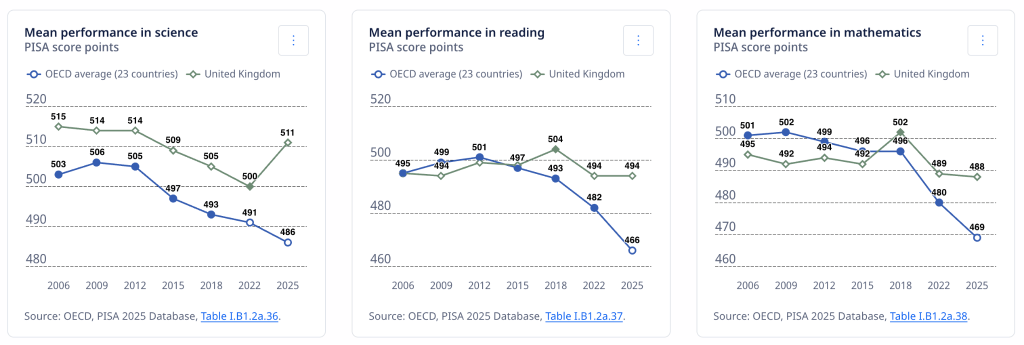
Trends become more convincing when they persist over time. Therefore, whilst the sustained decline in OECD performance is concerning, the notable improvement in the UK science score should be interpreted cautiously.
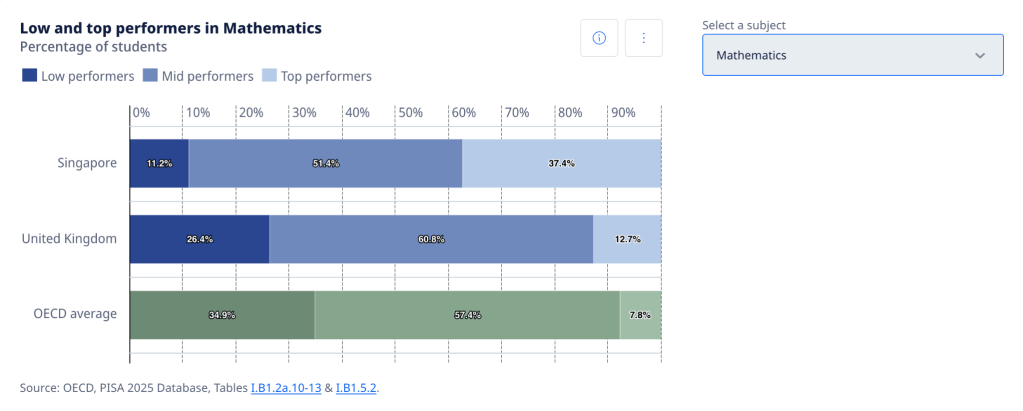
Focusing on the 2025 data, the graphic below reveals some of what the averages conceal. More than half of Singapore’s pupils fall into the ‘mid performers’ category, as do around three-fifths of UK pupils. There are striking contrasts, however, at either end of the attainment range: Singapore has almost three times the proportion of top performers, and fewer than half the proportion of low performers. These comparisons therefore present two clear challenges: to reduce the proportion of pupils below basic mathematical proficiency, and to increase the proportion reaching the highest levels. I will focus on the second of these challenges.
The first question is whether the gap in top performers is substantial and persistent. The chart below confirms this is the case with little ambiguity.
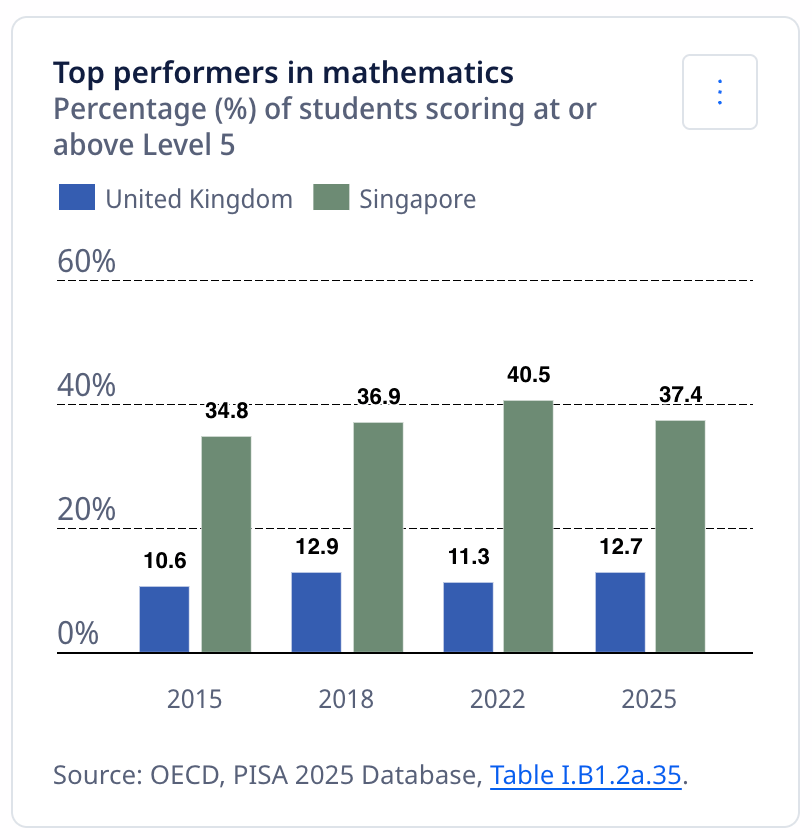
*These comparisons cannot tell us definitively which features of the respective systems account for the gap, but they give us good reason to examine how mathematical problem-solving is supported in Singapore.
The second question is what do we mean by ‘top performers’?
PISA defines these as pupils achieving its two highest proficiency categories, Levels 5 and 6, which should not be confused with GCSE grades.
Pupils at Level 5 can model complex situations mathematically, identify constraints and assumptions, and devise systematic strategies for solving challenging problems. They can recognise which mathematical knowledge to apply without being explicitly directed towards it, and evaluate their results in context.
Pupils at Level 6 can also tackle abstract problems with creativity and flexible thinking, recognising when familiar procedures can be applied in unfamiliar ways. They can connect different sources and representations of information, communicate their reasoning clearly, and critically evaluate their solutions.
These descriptors could have been lifted from almost any commentary on mathematical problem-solving.
The third question is how we might achieve change, ideally at scale.
Clear objectives are essential. A universally agreed definition of problem-solving is rather less so. Too often, discussion of how to develop these capabilities gives way to debate about what to call them:
- What makes a question non-routine, and for whom?
- Is problem-solving a distinct category, or an extension of mastery?
- Are there well-defined criteria which all problem-solving activities should meet?
These are legitimate questions, but they are a diversion.
Art and literary critics do not need a universally agreed definition of quality before they can explain why particular works deserve attention. Of course, there will still be much disagreement about which works should be considered the true masterpieces, and which are worthy of study. Nevertheless there is a broad recognition of what constitutes quality, and once a decision is made about which works to study teaching can move forward.
This might be compared to maths education in Singapore where investigations and discussion tasks are included in nationally approved mathematics textbooks. The activities do not all look alike and some problems will not be optimally formulated for all pupils. What is important, however, is that the tasks are high quality, and teachers are trained to deliver those tasks which are sensibly sequenced. They do not need to be retrained each year because there is consistency and predictability in the curriculum. This seems a fairly sensible arrangement.
A fourth question is whether we can emulate Singapore with our more decentralised system.
Decades worth of experience and data suggest this is not possible. It does need to be acknowledged that we cannot precisely measure the impact of curriculum in comparison to teacher training, recruitment or wider culture. We do not, however, need to disentangle every influence before adopting arrangements which make sense. Providing teachers with carefully selected and sequenced resources, supported by training in their use, is one such arrangement.
Essentially, the Singaporean system significantly reduces the amount of curriculum design that individual classroom teachers need to make. This is sensible because it can be time-consuming even just to select appropriate problem-solving questions. To write or identify high-quality investigations is highly time-consuming, and testing is required to ensure quality. For change at scale, we cannot reasonably expect every teacher to find, assess and sequence these activities independently.
MATS and departments need a manageable selection of high-quality problem-solving content (both questions and extended investigations) linked to the topics, with guidance on prerequisites, likely approaches and useful extensions. Furthermore, training should then centre on those resources, with teachers able to attempt the tasks themselves and compare approaches. This would have substantially more impact than any consideration of problem-solving credentials.
Another blog post, coming soon.
George Bowman
Founder, Maths Advance
george@mathsadvance.co.uk


Leave a Reply