

Society often emphasises the importance of solving real-world problems, with education seen as the gateway to achieving this goal. In mathematics, the UK’s National Curriculum highlights the need to “develop reasoning and problem-solving skills in a variety of contexts, including unfamiliar and real-world situations.” Similarly, the PISA framework champions “an individual’s capacity to formulate, employ, and interpret mathematics in a variety of contexts.”

Is Context All Important?
Answering this question fully would require significantly more than a single blog post! However, I propose that whilst context can be valuable, this is not necessarily due to it being “real-world”, rather that it is accessible and familiar to the learner.
Consider the equation below:
S = IE – (FE + UE) – M
Even if I were told this equation relates to energy in ecosystems, would that make it relatable or useful to me? Learning that M stands for metabolic energy expenditure, or that S is net energy stored might help, but what if I do not fully understand what constitutes a metabolic process or the units involved in the calculation? In this case, what should be simple arithmetic has been layered with complexity: the context hinders, rather than helps.
Contrast this with another lesson I taught on forming and solving equations. Here, I used angles in polygons and the perimeter of shapes to contextualise the concepts. These topics had been recently covered, allowing students to draw on prior knowledge to engage with the new material. Not only did this reinforce their understanding of polygons and perimeter, but it also provided an effective bridge into forming and solving equations. Although there was no attempt to make the context ‘real world’ it was effective nevertheless.
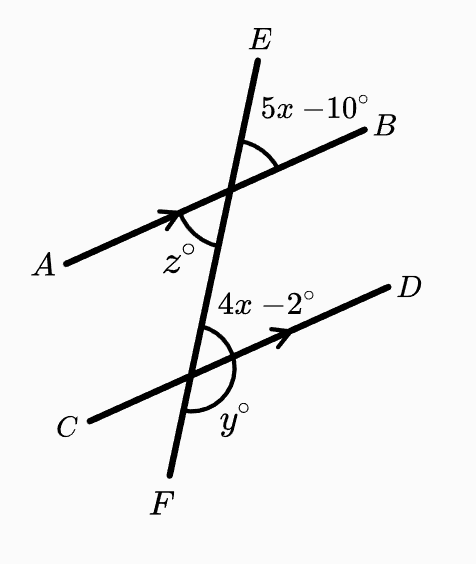
This aligns with the observation that high prior attainers will typically more easily grasp newly introduced concepts; it is just that the ‘context’ is pure mathematics and ‘familiarity’ is effectively understanding. When learning to solve quadratics, for example, the context is factorising into double brackets, solving linear equations, understanding factors and number bonds. Students who are more ‘familiar’ essentially have a better understanding of these foundational concepts, and tend to find it easier to engage with and master the new material.
The Value of Context
The experienced teacher reading this will likely be thinking of examples when she has used a specific real world context to great effect – football statistics for data representation, national flags for area of shapes, athletics records when teaching speed/distance/time – and I would encourage other teachers to embrace such ideas. Critically, however, football statistics are used precisely because they are familiar, whilst not all national flags will be familiar to all learners, the shapes within are, and there is also a novelty aspect, and speed/distance/time is also an intuitive concept. These contexts are valuable in providing curiosity and motivation, but the ‘familiarity’ of each is a necessity for prolonged learner engagement.
My Conclusion: Familiarity over Context
Whilst there can be significant value in describing real-world contexts in which new concepts can be applied, there is also the potential to hinder learning. Context should act as a bridge, not a barrier, but this has more to do with familiarity and accessibility, rather than “real-world” context per se.
How do you approach context in your teaching? Are there examples that have worked particularly well, or not so well? All comments are welcome.
Another blog post, coming soon.
George Bowman
Founder, Maths Advance
 MATHS ADVANCE BLOG
Leave a comment