
I regard Vygotsky’s Zone of Proximal Development (ZPD) as a fascinating concept. The universality of the idea makes it a powerful framework for learning of any kind.
Playing chess against Stockfish:
I enjoy playing chess, although I have never dedicated the time necessary to learn openings, mating nets etc. to take my game to the next level. Nevertheless, I have downloaded onto my phone an app called Stockfish, probably the most powerful chess engine in the world. No human has ever managed to claim victory over Stockfish in an official game, and many commentators speculate that Stockfish is so strong, no human will ever again be able to even draw a game against it. Stockfish is used to analyse human games, and grandmasters will use Stockfish’s analysis to improve various aspects of their own play. This is a time-consuming process, and requires a high level understanding of the game to improve further. I am certainly not of level to gain benefit by analysing the analysis of a chess engine.
Similarly, playing a game against Stockfish is close to a meaningless exercise. I may pick up very small adjustments I could make in the opening few moves, but by the middle game, the engine and myself are effectively playing different games. Every move I play is simply an exercise in delaying the inevitable, I never feel like I have a platform to build upon, and a strategy from my opponent that I cannot decipher soon brings defeat.

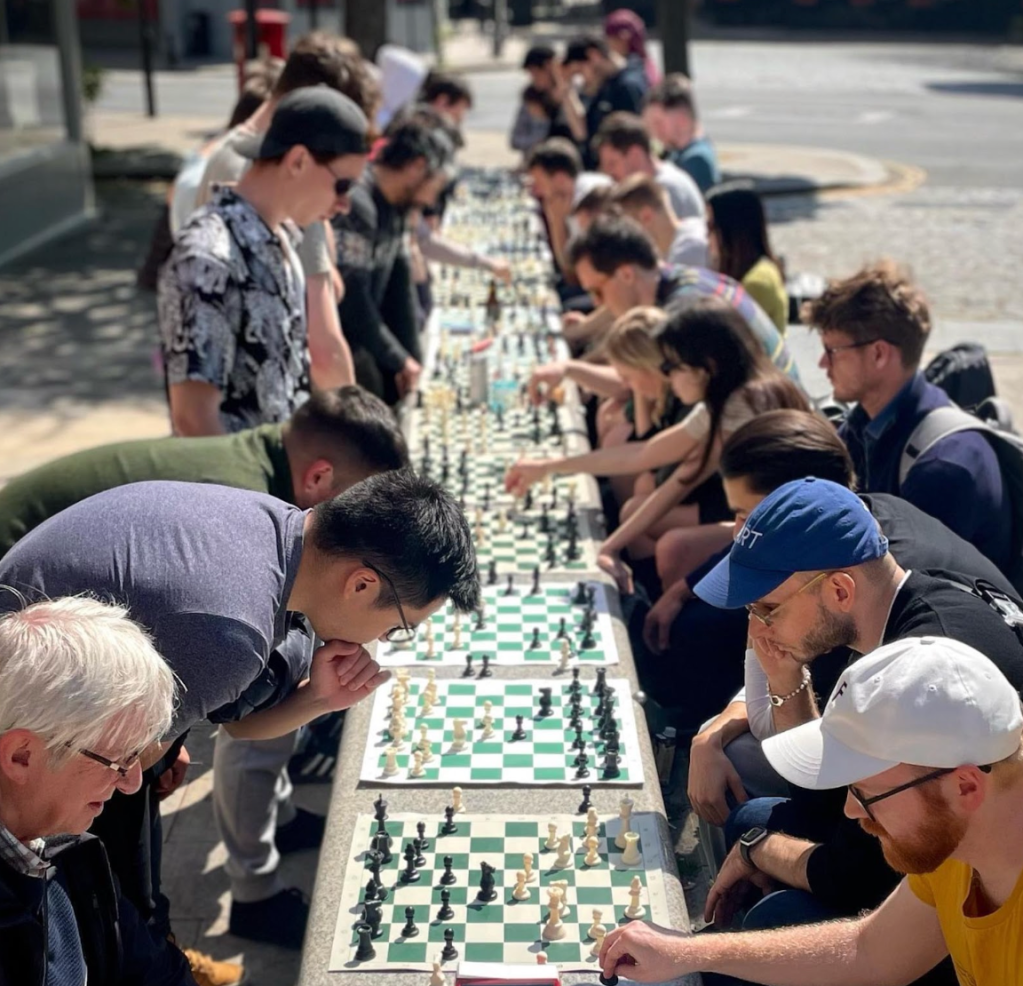
Playing Chess on Saturday morning on St. John’s Square in Clerkenwell is different, however. Even when matched against a superior opponent, I can appreciate how their approach might be more patient than mine, how they have used minor pieces to keep their king safe when it appears to be out in the open. My human opponents are of a level that even if not immediately reachable, is appreciable. They are considering relatively short lines, and their strategy is not so nuanced as to be imperceivable.
This mismatch reflects the heart of ZPD—when tasks are far beyond the learner’s current level, the learning experience becomes unproductive. A superior human player is still within my own ZPD, whereas Stockfish is too far superior. Against the latter the outcome is entirely predictable, and an understanding of the tactics used against me is unobtainable. In the words of Vygotsky, against Stockfish I am not just playing an opponent beyond my current ability, but one that is not even within reach. Furthermore, were Stockfish a human, she would probably not have considered playing the game as the exercise would have been entirely routine, possibly even patronising, and the victory unrewarding.
ZPD in Teaching and Questioning:
Teachers of Mathematics apply Vygotsky’s ZPD on a daily basis. The examples used to introduce different concepts will likely vary depending on the group being taught, with more or fewer fractions/negatives/surds involved for instance. Similarly, the vocabulary used might differ: ‘points’ or ‘vertices’; ‘unknown’ or ‘variable’ are just two examples. Furthermore, if a student is struggling with understanding how to factorise numbers, a teacher might simplify the problem by first asking about basic multiplication facts before moving back to factorisation. On the other hand, a student who grasps the concept quickly might be challenged to find the prime factorisation of much larger numbers or explore related concepts like greatest common divisors.
My focus in this post, however, is on the questions posed to pupils in independent or group work, particularly when provided by online platforms. This will then be linked to the motivations for creating Maths Advance, and the principles guiding its development.
To all intents and purposes the distribution of attainment in mathematics forms a normal distribution.

If learners are to make optimal progress they need to be operating within their ZPD, but how would one, two, three or more standard deviations of difficulty be manifested when teaching year 7 learners about prime factorisation, or year 13 Further Maths learners about volumes of revolution? When made reliant upon online learning platforms during the first lockdown, I was of the opinion that the middle chunk of pupils were being questioned appropriately in terms of the difficulty of questions, but those more than one standard deviation from the mean were not. There was no appropriate provision for learners in the bottom range of the normal distribution. If the platforms used are not responsive to the learner in real time they cannot address the gaps in his understanding systematically. This issue of unresponsiveness is more acute the closer you are to the extremes of the normal distribution, and therefore it was also a shortcoming for high achieving learners.
At those extremes it is more likely it is that a teacher or mediator is necessary to improve. One of the key principles of Vygotsky’s ZPD is that learners can only reach the next level of understanding with the assistance of a more knowledgeable other: a teacher, mentor, or even a peer, although it should be noted that this observation was made before the advent of AI. This mediator helps bridge the gap between what a learner can do independently and what they can achieve with guidance. In the context of both chess and mathematics, it is often the case that self-directed practice can only take a learner so far. To break through a plateau, learners frequently require targeted instruction or feedback from someone more experienced.
When adaptive technology is not responsive enough to individual needs, a mediator’s role becomes even more essential. The mediator can adjust the difficulty level, provide timely feedback, and ensure the student remains within their ZPD. For learners at both the top and bottom ends of the attainment spectrum, this human element is often the key to unlocking deeper understanding and fostering meaningful progress, and this was the motivation for creating Maths Advance.

I consider myself privileged to have worked with outstanding practitioners, particularly my first Head of Department, who was a true model of teaching excellence. I learnt so much from observing her classes. She had an exceptional ability to command the attention of the room without being seen as overly strict, her fairness and clear explanations were what stood out. Her teaching was consistently levelled to meet the needs of the class, adjusting to the group, in a manner consistent with Vygotsky’s ZPD. In my first year, when I taught a top-set Year 8 group, I would routinely seek her advice on extension tasks. She never hesitated to provide the perfect worksheet.
While not every teacher has access to such a mentor, it should not be a limiting factor. Reflecting on my practice, I have always believed that all teachers should have access to a wide range of problem-solving and challenge materials, tailored to meet the diverse needs of their learners. It is not enough to rely on generic platforms that cater to the middle; learners on both ends of the spectrum require thoughtful, well-targeted resources to thrive. Maths Advance was created with the conviction that high-attaining learners deserve access to thoughtful, well-targeted challenges that allow them to grow within their ZPD. Importantly, this does not mean simply moving on to the next concept, but rather offering challenges that deepen their understanding—promoting mastery without rushing through material. This principle of ‘challenge without acceleration’ is at the core of Maths Advance.
A post or two over half term. Coming soon.
 MATHS ADVANCE BLOG
Leave a comment